Writings & Research
Democracy Through Multi-Body Sortition: Athenian Lessons for the Modern Day
2013 | Journal of Deliberative Democracy
The breakthrough paper on Multi-Body Sortition: the comprehensive architecture for replacing elected politicians with everyday citizens. Or: How to structure a truly democratic, corruption-resistant national government.
2017 | Methods for Sustainability Research, Chapter 8
Democracies regularly fail to make long-term decisions in the interests of all humankind, let alone other living things and future generations. Sortition to the rescue.
Ignorance, Irrationality, Elections, and Sortition: Part 1
2022 | Common Knowledge, Duke University Press
While today’s elections are considered fundamental to democracy, they are structurally ill-suited for the task due to psychological biases, voter ignorance, and the corrupting effects of competitive power-seeking. Democracy would be better served by sortition—selection by lottery—to form representative bodies and select leaders.
Ignorance, Irrationality, Elections, and Sortition: Part 2
2023 | Common Knowledge, Duke University Press
Part 2 argues that sortition is the superior democratic procedure because it ensures descriptive representation and broad diversity. It also demonstrates how random selection overcomes rational voter ignorance and provides genuine accountability that elections cannot match.
Sortition Can Help Cure What Ails Our Democracy
2025 | Jacobin Magazine
Americans are frustrated with our increasingly oligarchic political system. Selecting an assortment of lawmaking deliberative bodies through random lotteries could help fix it, by empowering ordinary people rather than unaccountable politicians.
Why Hybrid Bicameralism is Not Right for Sortition
2018 | Politics & Society
Hybrid legislatures pairing elected and sortition chambers are structurally flawed and will inevitably undermine the citizen bodies. Instead, the essay proposes a fully multi-body sortition system, or incrementally transferring specific policy areas to citizen assemblies.
2013 | Systems Thinking World, with David Schecter
This paper critiques the inherent flaws of modern elected legislatures where a single body handles all functions. It proposes an idealized lawmaking model based on Athenian principles: random selection, dividing tasks across multiple bodies, and using temporary citizen juries for final decisions.
An Idealized Design for Government. Part 2: Executive Branch Accountability
2014 | Systems Thinking World, with David Schecter
This follow-up to the legislative branch paper extends the multi-body sortition model to the executive branch, asking how administrators can be made accountable without relying on elected chief executives. Bouricius and Schecter propose reducing executive power, strengthening independent oversight, and using randomly selected citizen bodies to curb corruption and keep government answerable to the people.
2017 | Fomite Interrogations: A Series of Tracts for Our Time Book 6
A short, accessible case for replacing elections with sortition—randomly selected citizens’ assemblies that deliberate like juries. Drawing on Athens, modern mini-publics, and firsthand legislative experience, Terry argues that ordinary citizens can govern more representatively, less corruptibly, and with better long-term judgment than professional politicians.
Terry’s Work in Context
Other writers on democracy by lot and Terry Bouricius’s contribution to it:
David Van Reybrouck · De Correspondent · 2014
Van Reybrouck presents Terry’s Multi-Body Sortition model as a blueprint for a democracy without political parties, elections, or a traditional parliament.
Read article →
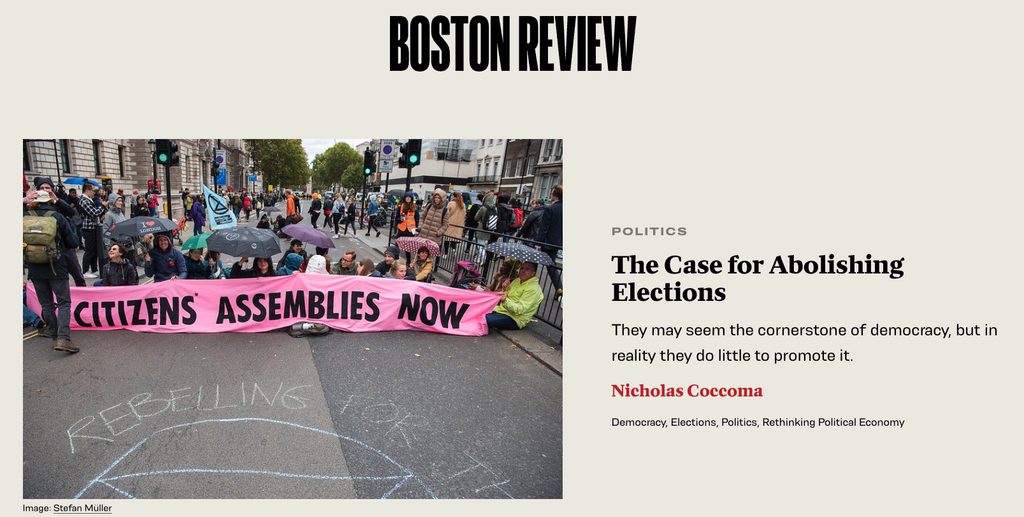
Nicholas Coccoma · Boston Review · 2022
A wide-ranging case for democracy by lottery, beginning with Terry’s experience in elected office and examining his Multi-Body Sortition model as an alternative.
Read article →